Exercise: Turning words into pictures.

When I first saw this exercise I was initially pretty excited. Doing this sort of quick, imaginitive visual shorthand is something I’ve been idly filling the margins of all my notebooks with since I was a child. I decided to challenge myself and pick one of the adjective words, going with wild.

I have to say, I found it pretty difficult. Initially I just drew some random images that came to my head when thinking of wild.

wtp

Actually, I feel like trying to use different mediums was a bit of a hindrance. It made everything lack continuity and feel disjointed. It also broke my rhythm, like “oh I’m enjoying this inking process but I guess now I should pick up a crayon and use that for a while”. It left me in a situation where I either try and more accurately meet the brief of the exercise, or try and commit to a process that felt more natural and stick to my pencils and pens. In general I just felt like the whole thing felt very uncoordinated and didn’t proffer a very satisfying result.

The next page didn’t feel much better, overcompensating in another direction.

wtp2

I ended up doing a loose drawing I thought was nice, but then feeling like I wanted to use a reference to fully realise the sketch. I searched on the web for sketches by some of my favourite artists, and spent some time looking at the work of Frank Frazetta (http://frankfrazetta.org/). I ended up with a few studies that were quite well realised drawings. I have to say, I quite like this page, but feel like it wasn’t at all meeting the brief. This was really just doing some nice sketch practise and not challenging myself to get the intended meaning of the exercise. I wrote some notes about my feelings on the exercise, wondering how to do something spontaneous and visually explorative, relying only on my imagination without devolving into jumbled mess.

I re-read the exercise and focused on one section. The wording specifies that if the word conjures a scene, imagine you are moving around the scene with a camera and recording each element to create a visual checklist, a catalogue of images. I did the exercise one more time, this time trying to imagine a scene that I could move around and explore.

wtp3

I feel much happier with this result, and it matches up better with what I think my creative process might be like in the future as a working illustrator. I tried to picture a weird little vignette to take snapshots of, and let myself fill in the blanks with my drawings. The quality of the drawings are not the best, but I’ve made something fun that I would enjoy going back and developing with more detailed drawings.

On reflecting on the exercise I think my mood had a lot to do with the results. I had had some prior commitments during the day I first attempted it, and was pretty tired and disinterested by the time I got around to it. I’m glad I spent the time necessary to get the most out of the exercise.

Exercise: Spider Diagrams

This exercise called for me to make a number of spider-diagrams around four predetermined words. I then had to get another person to repeat the exercise, and compare the results.

I had fun doing this exercise. I often do similar word association exercises during my normal creative process, so I didn’t have very much trouble working on my diagrams. What I do have trouble with, is legibility! On top of my, uh, unique hadwriting, I was working on a sketch in markers on the reverse of the page and didn’t notice it bleeding through to my diagrams. So it’s a mess. I decided to recreate them digitally. I also took the opportunity to introduce some colours and textures.

I got my girlfriend to do the exercise, and added in her words to my diagrams in a different colour. I tried to create different styles for the different words. We actually had more words in common than I thought.

The most difficult word for me was probably childhood. Which I found pretty interesting. The words for childhood that me and my girlfriend came up with were both a little bleak. I didn’t have the happiest of childhoods, and that was probably reflected in the words I did come up with. I suppose I could have tapped into that and come up with more and more words along those lines, but I guess I had some anxiety about making things very specific and personal in an exercise that I would be sharing publicly.

In contrast to some of the other students’ exercises that I looked at when browsing other blogs, I found angry quite easy. Being an emotion, it was very open-ended and allowed me to just freely associate things and come up with a lot of words quickly. Actually trying to tie emotions into my creative process helped me to come up with more words, and importantly, more interesting words. When doing festival, it helped to think of being anxious or excited and see what words came out of those feelings.

This is something I will try to do more of in the future.

ex2-4ex2-3ex2ex2-2

Exercise: Writing a brief.

For this exercise I need to find an existing illustration that resonates with me, and retroactively write a brief for the creation of that illustration.

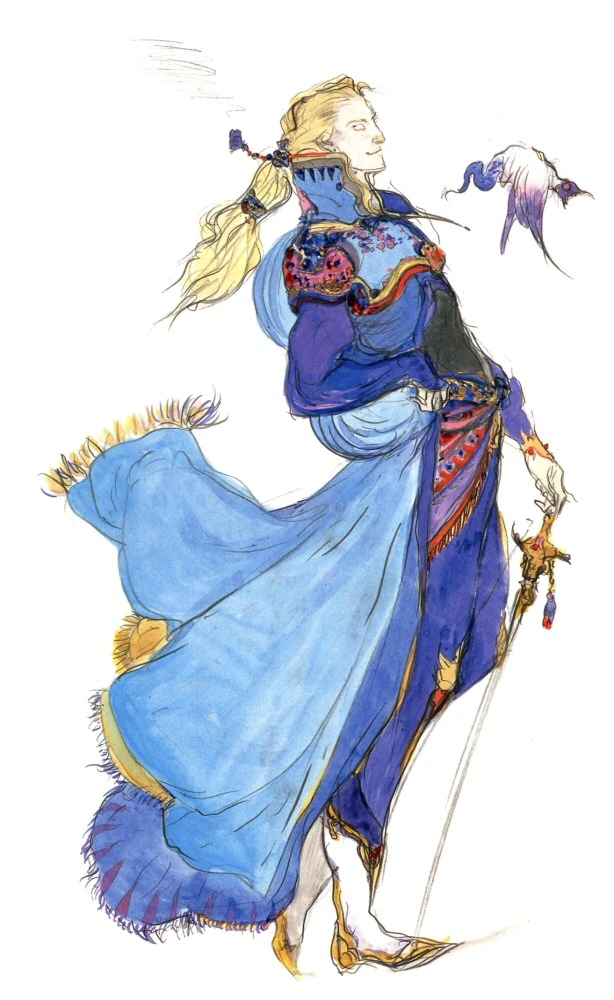
When considering an illustration for this exercise, I immediately thought of an art book I recently purchased Final Fantasy: Ultimania Archive. It includes many illustrations from one of my favourite concept artists, Yoshitaka Amano. I spent some time looking through the book for pleasure, and settled on this beautiful character artwork for the character Edgar, from Final Fantasy VI. I always liked that character when I played through the game as a child, and I think this artwork captures him so well, I chose it for this exercise.

The artwork can be seen here: https://vignette.wikia.nocookie.net/finalfantasy/images/a/a8/Ff6_edgar.jpg

Here is the brief I came up with:

Brief

Character artwork for upcoming Final Fantasy VI: we want you to continue your character design work bringing to life the character of Edgar Roni Figaro. He is male, age 27, and king of Figaro Castle. He is a very regal figure, and this should be reflected in the artwork. Tall and proud, he is emits an air of pomp and circumstance. However he is also playful and quick-witted, and a notorious womaniser, something used for comic effect throughout the story. His combat class is one of machinist and his penchant for invention should manifest visually in eccentricity. He is noble, strong, and cunning.

Crucial to the portrayal of Edgar is his underlying complexity. He assumed the throne not through ambition, but duty. While outwardly allied with The Empire, he is in fact cooperating with a subversive rebel group, The Returners. We need to believe that underneath his confidence he hides his insecurities, his self-doubt.

In terms of attire, his native land is surrounded by desert, so perhaps billowing fabrics should be used. They should be dyed in various strong, regal colours. The surrounding world is one of fantasy and future. There are powerful technologies and advanced machines, but also magic and adventure. Their landscape is filled with strange, alien creatures.

The purpose of the illustration is to assist our team in developing the look and feel of the character, designing the spritemaps around the image, and basing the in-game portrait around his appearance. While this image itself will not appear in the game due to technical limitations, it will be included in the manual and in various promotional materials.

The game’s audience is primarily male youths, but the FF series has broader cross-gender appeal than many other successful video games, so perhaps this can be reflected in the world design. We would like you to work consistent with your previous work on the series, expressive ink line work and bright water-based paints.

________________________________________________

Reflection

I found this exercise to be an interesting challenge. To consider approaching an illustration from the perspective of a commissioner is something I’ve never done before. I tend to develop my ideas quite visually, with sketches and doodles. So to really think it out and write a piece of text was a different experience. To have to write out what I want instead of just scribbling it. I did enjoy pretending to be an art director on one of my favourite games though!

Ref

Final Fantasy Ultimania Archive: Volume 1. Dark Horse, 2018.

Exercise: Getting the Gist

For this exercise I needed to illustrate an editorial from a newspaper or magazine.

My first mission was to obtain a newspaper. Quick pop out to a nearby shop, and a copy of the Irish Examiner:

5

I read the newspaper in search of a suitable article (got mildly distracted by the crossword… and maybe a sudoku or two…) and started doodling up some concepts from some of the most appealing articles.

1

It was an interesting process. I found it quite challenging to find fitting articles, and there was really only one or two that I felt worked for this exercise. Maybe I was inspired by Mr. E.H. Shepard from the last exercise because most of my ideas were political cartoons.

4

Among my rejected ideas was An Taoiseach (Prime Minister) literally running away from Ireland’s ubiquitous housing crisis. In the end I decided on an editorial about a new report from the Department of Finance. Ever since the bail-out of Irish banks following the 2008 crash, they’ve effectively been operating with tax exempt status. This report concluded that if banks are forced to repay their substantial backlog of taxes, it’s likely that they will raise rates and harm ordinary bank users, despite the banks making enormous profits year after year. This apparently was reason enough for the Minister for Finance to extend the banks tax exemption indefinitely.

3

Inspired by the ridiculousness of this situation and feeling like it would be something easy to satirise, I started developing some ideas for an illustration.

2

Immediately I thought of having two fat bankers, totally confused as to why they would need to pay taxes, and oblivious to their own excess wealth. What I found interesting about this process was that as I developed the idea more I tended to confuse the central idea and over clutter the image, literally and conceptually. They weren’t necessarily bad ideas, but once I was incorporating the Minister for Finance leashed inside the banking HQ to a nearby dog kennel with “Department of Finance” written on it, I was certainly amusing myself! But I think adding too much visual information to the piece. I took it back to my basic idea, satisfied that I had come up with something funny and relatively straightforward to complement the piece.

For this exercise I decided to do the drawing digitally. I’m not very used to drawing a more cartoon-ish style, and I was finding it difficult to get the faces exactly the way I wanted them in my sketchbook. I figured that I’d be a little more comfortable working digitally and being able to move things around and erase liberally without compromising the drawing at all.

I started with a base sketch that I would add neater lines over afterwards. I was actually pretty happy with the result, and didn’t need to alter the base image very much in my second layer.

6

For a sketch layer the lines are already fairly neat. If I had to do the exercise again I would probably try to be a little more fluid and sketchy at this stage of the drawing, hopefully allowing things to be a little more dynamic and expressive. Still, I don’t think the result is very bad.

Adding the linework was straightforward. I decided to do the font by hand, feeling like it would go with the aesthetic of the cartoon.

7

I haven’t done much handwritten elements like this before. I tried to go for the subtle comic-book art of making certain words slightly bold, and I think the effect adds a little touch of professionalism and looks really nice.

I had a little trouble choosing a good header, once again adding a little too much information. I had to constantly remind myself throughout this exercise to keep things simple! In the end I tried to distill it as much as possible, and hopefully managed to communicate the idea pretty simply.

Finally I added a splash of colour. I didn’t want to go for any complex shading or anything. Just a few block colours, done in a way to mimic traditional paint. I think it goes with the overall look of the drawing and helps to communicate certain aspects, like the mountains of gold, better than the simple line drawing.

Below is the final illustration.

8

Ref

McEnroe, Juno. “Consumers hit if banks forced to repay tax, report warns.” Irish Examiner 17 September 2018.

Exercise: The History of Illustration, part 3: Drawings.

The final step is to draw something in the style of my two chosen illustrators. I decided to do the challenge by choosing the same subject for both drawings to really demonstrate the differences in style. I decided to draw a pig wearing a trench coat, because I felt like the imagery worked within the styles of both illustrators and also because I like pigs.

I started off with some loose sketches.

12

At this point I got the idea to include a background element. I thought about what imagery would work and straight away I thought of a nearby street in my hometown which I always liked for it’s old red brick buildings. I headed out and took a few reference photos.

9

Once I was there I thought I would move away from the flat perspective I initially sketched and try to challenge myself with a one-point perspective angle. I couldn’t get exactly what I wanted so in the end I decided to composite a few different references.

Using my (limited) knowledge of perspective I drew out some contruction lines before moving onto inking.

13

When doing the drawing in E.H. Shepard’s style, I wanted to stay out of my comfort zone and do the inking without first doing a pencil undersketch. I hoped that this would take advantage of the permanence of ink as a medium, and allow the work to be a little more expressive. For extra style points, I used an old fashioned dip pen and a jar of ink.

6

I’m not very used to using a dip pen, but I was excited by the challenge.

Here’s a work-in-progress shot of Mr. Pig.

8

I found it difficult to capture Shepard’s overall style and struggled with his way of crosshatching.

7

Looking at it now the perspective is definitely less than perfect, but I like the expression on Pig’s face. I couldn’t capture the expressiveness of Shepard, but I suppose that’s to be expected.

Moving on, I began drawing my Mignola tribute. I started with a pencil sketch and then went on to inking. I know from watching interviews that Mike uses a Staedtler fineliner, usually a 0.3 or 0.1mm. Luckily I happen to have the very same tools, so no need for my fancy dip pen!

14

To try and emulate the process a Mignola drawing goes through from sketch to print, I went ahead and scanned the image and began work digitally touching it up and filling in the blacks.

11

2

This exercise really made me appreciate Mignola’s masterful control over form, and his use of that deep black contrast to give definition and shape to his characters and backgrounds. Mine is a pretty weak emulation, but I still like its graphic nature.

Around this time I got the idea that I would paint over my Shepard drawing, just like how the coloured illustrations were in many of his books. Luckily I drew the picture on Bristol board. While not the best surface to paint on, it can take a neat layer of paint without excessive warping. I broke out my favourite set of Sennelier watercolours and got painting.

10

I tried to stick to the loose, solid-colour style you see in the Winnie-the-Pooh illustrations. It was hard to get even washes, which was at least partly due to the Bristol board. But I think it still captured that kind of childrens’ storybook vibe.

Then I began finishing touches drawing #2, tidying it up a bit and adding in colour.

3

I had one last idea. Transform the Mignola drawing into a cover for my porcine friend’s very own pulp serial, using the corniest title I could think of: P.I. Pig. I spent much longer drawing the title than I intended, but I’m pretty happy with the result.

To match, I made my Shepard drawing into a page from an illustrated children’s book. I just wrote whatever rubbish I could think of at the top of the page. Luckily this course isn’t about my creative writing skills! I decided to stick with my detective theme, digging his little scarf-trenchcoat ensemble.

Here’s the final pieces, and the completion of my first exercise for the course.

5

4

Exercise: The History of Illustration, part 2: Bios and Notes.

E.H. Shepard

Ernest Howard Shepard (1879-1976) was born in London. Interested in becoming an artist from early in his youth, he attended several art schools and eventually the Royal Academy.

Shepard said of himself that he was “no good” at oil painting, and decided to give up any fine art pursuits in favour of becoming a freelance professional illustrator.

Following a number of accepted contributions, Shepard was offered a seat at the table of Punch Magazine, a relationship that would span more than 50 years and 1,500 illustrations.

Shepard’s best known work is his illustrations for The Wind in the Willows and Winnie-the-Pooh, the latter of which he would purportedly go on to regret, lamenting that a “silly old bear” overshadowed much of his lifetime of work.

Nonetheless, Shepard is remembered today for his iconic line drawings whose charm was integral to the success of the original publications of Winnie-the-Pooh.

In terms of cultural context, Shepard survived two World Wars, which informed much of his political cartooning. He received the Military Cross for his service during WWI. In WWII, he lost his son, Graham, who served as much of the inspiration for Christopher Robin.

___

When comparing the styles of my two chosen illustrators, Shepard and Mike Mignola, you immediately notice the round versus the straight. Shepard, all expressive, curved linework, and Mignola, geometry, angles, hard edges. Shepard uses gentle hatched shading, Mignola, heavy blacks, high contrast blocks of shadows.

Although both artists favour simple traditional tools, their production workflows would have been quite different. In Shepard’s time they would have used lithographic printing, a process he was likley quite removed from. Mignola’s books are usually coloured and lettered by different artists, a process that involves some collaboration, with Mignola famous for his choices of bold colours that are utilized for all sorts of interesting narrative effects. Mignola’s comics work is also coloured digitally, with much of modern production handled that way.

___

Answering questions.

  • Did the work of the illustrator you chose from the list seem old fashioned? If so what was it that made it seem so?

I suppose obviously in terms of subject matter- political cartoons in the 20th century and anthropomorphic animals in Edwardian Britain- Shepard’s work has a dated quality. The rendering too has a sort of rounded quality I notice in illustrators of that time.

  • What was it about the contemporary artist that attracted you to their work?

Before I started reading any of Mignola’s comics, I fell in love with his covers. I love the bold contrast and geometry of it. He uses black in such a way not necessarily to accurately portray a light source, but to give his forms a certain shape that’s visually appealing.

After buying some of his collections, now I stick with him not just for his artwork but for his dry humour, interesting characters and dark, pulp-y stories.

  • How did each artist produce their illustrations- what tools and materials did they use?

Both artists prefer a simple approach. Pencil sketches and ink pen rendering. While both have dabbled in more conventional fine art, their most celebrated work uses largely the same traditional materials.

___

Exploring style

Below are some sketchbook pages examining the respective styles of the two illustrators.

sb3

sb2

I found this exercise pretty hard. I’m not used to emulating specific artist’s drawings. I found it very difficult to emulate E.H. Shepard in particular. The hatching style is not something I’m used to and it was difficult to make the drawings feel natural and expressive. Even though the Mignola sketches are a crude imitation, I found that after a while I got caught up in the types of shapes he likes to use and started to enjoy riffing on his style.

___

References:

Benson, Tim. “The Man Who Hated Pooh.” BBC News. BBC News 6 March 2006. Web. 13 September 2018.

Daoust, Phil. ” ‘When I die, let him decorate my tomb’: Can you imagine Winnie the Pooh or Wind in the Willows without EH Shepard’s charming, carefree illustrations?” The Guardian. The Guardian 9 December 2000. Web. 13 September 2018.

Campbell, James. “E.H. Shepard and the First World War.” Art UK. Art UK 12 March 2016. Web. 13 September 2018.

“E.H. Shepard.” Illustration History. June 2018. Web. 13 September 2018.

Exercise: The History of Illustration, part 1: Choosing the Illustrators.

From the list of illustrators available I chose E.H. Shepard.

http://www.artnet.com/artists/ernest-h-shepard/

I remember reading a beautiful hardbound copy of Winnie-the-Pooh when I was a child. The illustrations stuck with me over time, so choosing E.H. Shepard seemed obvious to me. His work has a sort of serene quality that hints at more complexity than the whimsical characters initially let on. Being personally a fan of satire and subversion, I was interested in reading about his life as a war artist and political cartoonist. His loose, sketchy approach was also appealing, with uneven, expressionistic linework and hatching.

I wasn’t able to find that book from my childhood, but I did visit my local library and managed to find something similar, a harcover edition of the original Pooh stories. I’ll include it below under references.

___

http://www.artofmikemignola.com/art

For my modern illustrator I decided to celebrate my ongoing love affair with the work of Mike Mignola. I did this for two reasons:

1) I thought it would be an interesting juxtaposition given Mignola’s love of hard lines and very geometric shapes, clean hatching and lots of angles. But also with more similarities to Shepard than you might initially think. With both having a dry sense of wit, showing interesting and diverse characters and crucially having an almost melancholic undercurrent throughout their body of work. When I think of emotions I associate with both artists, I think of loneliness, anxiety, etc.

2) I find it personally amusing to compare Winnie-the-Pooh to my beloved Hellboy.

Rather than reeming off my whole collection, I thought I’d include two of my favourties, his seminal collection of Hellboy short stories, and his later work, the joyfully esoteric The Amazing Screw-on Head.

Sketchbook:


sketchbook


Refs:

Milne, A.A and Shepard, E.H. Winne-the-Pooh. Great Britain: Methuen, 1987.

Mignola, M. Hellboy: The Complete Short Stories Volume 1. China: Dark Horse, 2018.

Mignola, M. The Amazing Screw-On Head and Other Curious Objects. China: Dark Horse, 2010.